How to Play Padel: A Beginner's Guide
Padel is a doubles racket sport played on an enclosed court about a third smaller than a tennis court. You serve underarm, diagonally across the court. The ball may bounce only once on your side, and once it has bounced you can let it rebound off the glass walls before you return it. Scoring works almost exactly like tennis.
That's the short answer. The rest of this guide explains how to play padel : how to serve, how a rally works, how to deal with the walls, where to stand with your partner and which shots to learn first. It finishes with a step-by-step plan for your first match and the mistakes almost every beginner makes.
How padel works: the basics
-
Players: Padel is almost always played as doubles, two against two.
-
Court: The court is 20m long and 10m wide. It is enclosed by glass walls at either end, and glass and metal mesh along the sides.
-
Serve: Serves are underarm. You bounce the ball and strike it at or below waist height, diagonally into your opponents' service box.
-
The bounce: The ball can not bounce more than once on your side. You can also volley it, meaning you can hit it before it bounces, except when returning a serve.
-
The walls: After the ball bounces on your side, you can play it off your own walls. Your shot must land on the ground on your opponents' side before it touches any of their walls.
-
Scoring: The scoring works the same as tennis: 15, 30, 40, game, with sets usually played to six games.
The court and equipment you need
The court is split in half by a net, and each half has two service boxes which are marked by a service line and a centre line. The playing surface is usually artificial grass with sand, which can affect how you move and what footwear will suit it.
To play, you will need three things:
-
A padel racket. Padel rackets have no strings. They're solid paddles with a series of small holes, a foam core and a wrist strap. Beginners usually work best with a round-shaped racket, which is more forgiving on off-centre hits.
-
Padel balls. They look like tennis balls but are slightly less pressurised, so they bounce a little lower.
-
Suitable shoes. Court shoes which have a padel or tennis-style sole grip artificial grass a lot better than running trainers, and are more suited to the side-to-side movement padel demands.
Many UK venues hire out rackets, so you don't need to buy everything before your first game. If you're ready to get your own kit, our guide to the best padel racket for beginners explains what to look for. You can also explore our padel rackets, padel shoes and padel balls.
How to serve in padel
Every point starts with a serve. Beginners often worry about it, but the padel serve is surprisingly much simpler than a tennis serve.
-
Stand behind the service line on your side of the court, between the centre line and the side wall.
-
Bounce the ball once on the ground behind the service line.
-
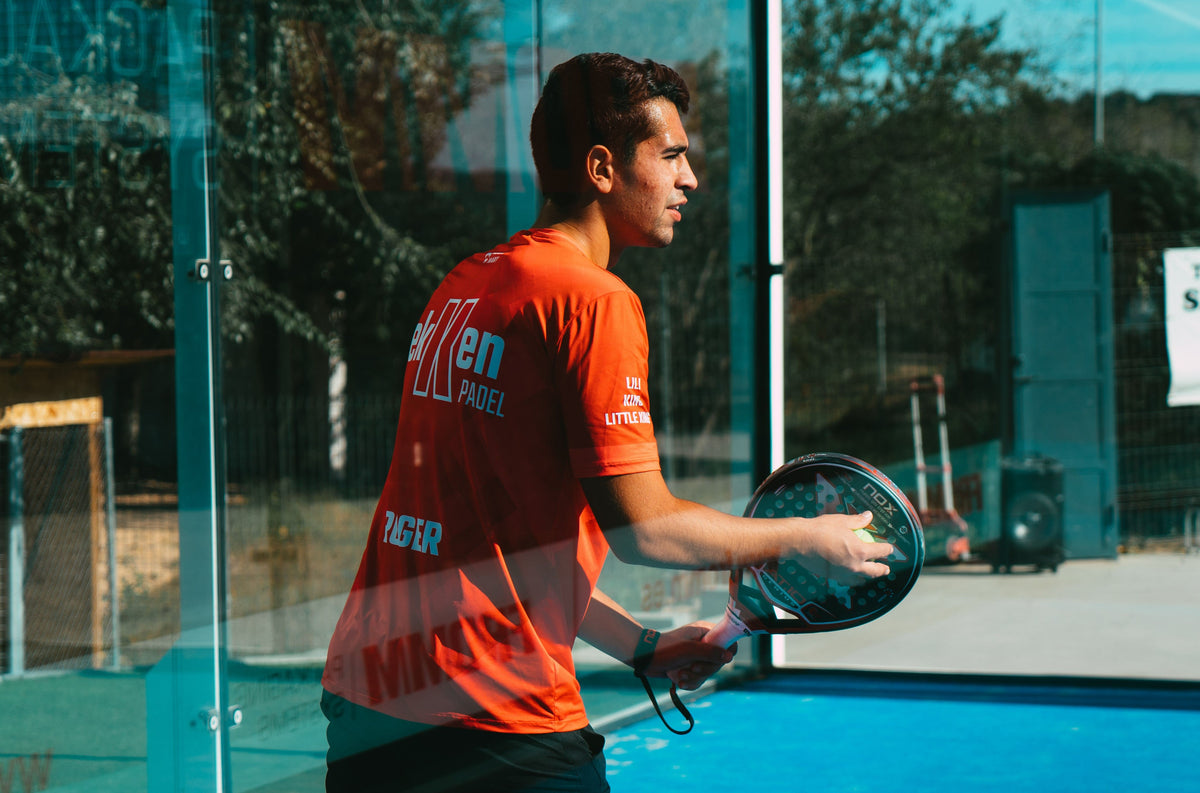
Hit it after the bounce, at or below waist height. Overarm serves aren't allowed, and you must keep at least one foot on the ground as you strike.
-
Aim diagonally into the service box opposite you.
-
Make sure it lands in the box. It may then hit the back glass and still be good. If it hits the metal mesh after bouncing, it's a fault.
You have two attempts, just as in tennis. If the serve clips the net and still lands in the correct box, it's a let and you serve again.
The receiver must let the serve bounce before returning it. You can't volley a serve.
Beginner tip: Accuracy matters far more than pace. A steady, deep serve to your opponent's backhand will win you more points than a fast one that lands out. For a fuller breakdown of rules and technique, read our guide on how to serve in padel.
How a rally works
Once the serve has been returned, the point then becomes a rally. Three rules cover almost everything that happens:
-
The ball may bounce no more than once on your side before you hit it back.
-
You can volley at any time, except when returning a serve.
-
Your shot must bounce on the ground on your opponents' side before it touches their walls or fencing. If it hits their glass or mesh first, you lose the point.
You win the point when your opponents can't return the ball legally. That could be either because it bounces twice on their side, they hit it into the net, or they send it into your walls before it bounces.
How to play the ball off the walls
The walls are what make padel feel different from tennis. Most of the difficulty for new players comes from not knowing when to let the ball go.
The key rule is simple. Once the ball has bounced on your side, it stays in play even after it hits your back glass or side glass. You can then hit it as it comes back off the wall.
Here's how to deal with the back wall as a beginner:
-
Don't rush it. If a ball is going past you and it is obvious that it will reach the back glass, let it. It will come back towards you, often more slowly.
-
Turn sideways early. Open your shoulders towards the side wall so the ball comes off the glass into your hitting zone, not your body.
-
Move forward with the ball. Step towards the net as it rebounds instead of backing into the corner.
-
Keep the return simple. Aim for a controlled shot through the middle or a lob, not a winner.
The metal mesh behaves differently from the glass. It produces unpredictable, often dead, bounces. Beginners should treat mesh rebounds as a bonus rather than something to plan around.
You can also hit the ball against your own walls to get it back over the net. However, this is a more advanced skill and isn't something you need to worry about early on.
For a detailed look at legal and illegal wall contact, see our guide to whether the ball can hit the glass wall or metal fence in padel.
Positioning and playing as a doubles team
Good positioning matters more in padel than in almost any other racket sport. The pair that controls the net usually controls the point.
Choose your sides
Each player takes one half of the court, left or right, and generally stays on that side for the whole set. You take it in turns to serve from your own side. It's a lot easier to agree on sides before you start, as swapping mid-set can get confusing.
Two positions: at the net or at the back
At any moment, your team should be in one of two positions:
-
At the net: Both players stand roughly two to three metres from the net. This is the attacking position, where volleys and overheads win points.
-
At the back: Both players stand behind the service line, close to the back glass. This is the defensive position, where you return the ball, use the walls and lob.
The area around the service line is often called "no man's land". It's the hardest place to play from, because balls often land at your feet. Try to pass through it rather than stand in it.
Move as a pair
Picture yourself and your partner connected by a rope about three metres long. When one of you moves forward, the other follows. When one is pushed back, the other moves back too. Leaving a big diagonal gap between you is the easiest way to lose points.
Take the net and win it back
After serving, move forward towards the net with your partner. If your opponents lob over your heads and push you back, a good lob of your own is often the best way to swap places and retake the net.
To learn whether padel can be played without a partner, read Is padel always played as doubles?
Padel techniques for beginners
You don't need many shots to enjoy padel. These five will carry you through your first months on court.
The grip
Most coaches teach the continental grip. Hold the racket as if shaking hands with its edge, with the face roughly perpendicular to the ground. It lets you hit forehands, backhands, volleys and overheads without changing your grip, which helps in fast exchanges at the net.
Always put the wrist strap on before you play as it stops the racket flying if it slips out of your hand.
Ready position and the split step
Stand with your feet shoulder-width apart, knees slightly bent, and the racket in front of your chest. As your opponent hits the ball, make a small hop so you land balanced and ready to move in either direction. Coaches call this the split step, and it's one of the most useful habits to build early.
Forehand and backhand groundstrokes
Keep the swing compact. Padel doesn't need the big, looping tennis swing. A short take-back, contact in front of your body and a controlled follow-through towards your target will give you more consistency.
Aim for depth and control, not speed.
The volley
At the net, use a short punching motion with very little backswing. Keep the racket face slightly open, ie. tilted back a little, and block the ball deep or towards your opponents' feet. Most beginner volleys go wrong because the player swings instead of blocking.
The lob
The lob is padel's most important defensive shot. When you're under pressure at the back, a high, deep lob over your opponents' heads forces them away from the net and gives your team time to move forward.
A lob that lands short, however, invites an easy smash. Aim to land it close to their back glass.
The bandeja (a shot to learn next)
The bandeja is a controlled, sliced overhead hit from around head height. It lets you deal with a lob while staying in a strong position near the net. It's not a beginner shot as such, but it's worth learning early. It stops you trying to smash every high ball, which is a common source of mistakes.
How scoring works (in brief)
Padel uses tennis scoring:
-
Points: 15, 30, 40, then game.
-
Games: A set is usually won by the first pair to six games with a two-game lead, with a tie-break at 6–6.
-
Matches: These are commonly the best of three sets.
Many recreational games and some competitions use a golden point at 40–40 (deuce). The next point simply wins the game, which keeps matches moving.
Agree to the format before you start. Our guide to how padel scoring works covers deuce, tie-breaks and the scoring variations you're likely to meet.
Your first padel match, step by step
If you're wondering how to start playing padel, here's a simple plan for your first session.
-
Book a court. Most UK venues let you book a court for four players online, often in 60- or 90-minute slots. If you don't have three friends to play with, many clubs run beginner sessions or social games where you can join others.
-
Sort your kit. Check whether the venue hires rackets. Wear court shoes if you have them and comfortable sports clothing, and bring water.
-
Warm up for 10 minutes. Start with gentle rallies from the back, then volleys at the net and a few overheads. Let some balls come off the back glass so you get a feel for the rebound.
-
Agree the format. Decide who plays on which side, whether you're playing golden point, and how many sets you have time for.
-
Decide who serves first. Spin a racket or toss a coin.
-
Play the first few games for rhythm, not results. Focus on getting serves in, getting the ball back over the net and moving with your partner.
-
Keep the etiquette simple. Call the score before serving, return stray balls to the server, and don't step on to the court next door to retrieve a ball mid-point.
-
Review afterwards. Note one thing that went well and one thing to work on next time. Many venues offer coaching, and a lesson or two early on makes a noticeable difference.
Common beginner mistakes, and how to fix them
|
Mistake |
Why it costs you |
How to fix it |
|---|---|---|
|
Hitting every ball as hard as possible |
Power shots bounce high off the back glass and give opponents an easy return |
Prioritise placement: aim low, deep or through the middle |
|
Using a big tennis-style swing |
Long swings are hard to control in fast exchanges and at the net |
Shorten your take-back and finish towards the target |
|
Hitting the ball before it reaches the glass |
You end up rushing awkward shots in the corner |
Let balls that are clearly going to the glass rebound, then play them |
|
Standing in no man's land |
Balls land at your feet, which makes clean shots very difficult |
Commit to the net or the back, and move through the middle quickly |
|
Leaving a big gap between you and your partner |
Opponents can hit through the space |
Move forward and back as a pair |
|
Trying to smash every high ball |
Smashes often bounce back into play off the glass, or go out |
Use a controlled overhead, or let the ball bounce and play it off the wall |
|
Hitting lobs too short |
A short lob sets up an easy smash for your opponents |
Aim high and deep, so the ball lands near their back glass |
|
Playing in running trainers |
Running shoes give poor grip and lateral support on sandy artificial grass |
Wear padel or court shoes with a suitable outsole |
Practical tips to improve faster
-
Play the middle. Shots down the centre cause hesitation between opponents and reduce your risk of hitting the side walls.
-
Talk to your partner. Short calls like "mine", "yours", "leave it" or "switch" prevent clashes and missed balls.
-
Play with slightly better players. You'll pick up positioning and shot selection quickly.
-
Practice off the glass. Ten minutes of letting balls come off the back wall during a warm-up builds confidence faster than anything else.
-
Book a beginner lesson. A coach can help fix your grip and positioning before bad habits begin to form.
Frequently asked questions
Is padel easy to learn?
Padel is widely regarded as one of the easiest racket sports to start. The court is small, the serve is underarm and the walls keep the ball in play for longer. Most beginners enjoy proper rallies in their first session. Playing well takes longer, because positioning and wall play take time to master.
How do I play padel if I've never played a racket sport?
Start with a beginner session or lesson if your venue offers one. Focus on three things: getting the ball over the net, letting balls come off the back glass, and moving with your partner. You don't need any previous tennis or squash experience to begin playing padel.
Can you hit the ball before it bounces in padel?
Yes. You can volley the ball at any time during a rally, except on the return of a serve, which must bounce first.
Can you serve overarm in padel?
No. The serve must be underarm. You bounce the ball first and strike it at or below waist height.
Can you play padel with two people?
Singles padel exists, but it's much less common and usually played on a narrower court. Most clubs and courts are set up for doubles.
Do I need my own padel racket to start?
Not necessarily. Many venues hire out rackets, which is a sensible way to try the sport. Once you play regularly, your own racket gives you consistency and a better fit for your game.
Start playing with confidence
To recap the essentials: serve underarm and diagonally, and let the ball bounce no more than once on your side. Use the glass to give yourself time, and move up and down the court with your partner. Keep your swings short, aim for placement over power, and lob when you're under pressure.
Everything else comes with time on the court.
If you're building your first kit, start with our guide to the best padel racket for beginners. You can also browse our padel rackets, padel shoes and padel balls to find equipment that suits your game.